
Abraham Cahan
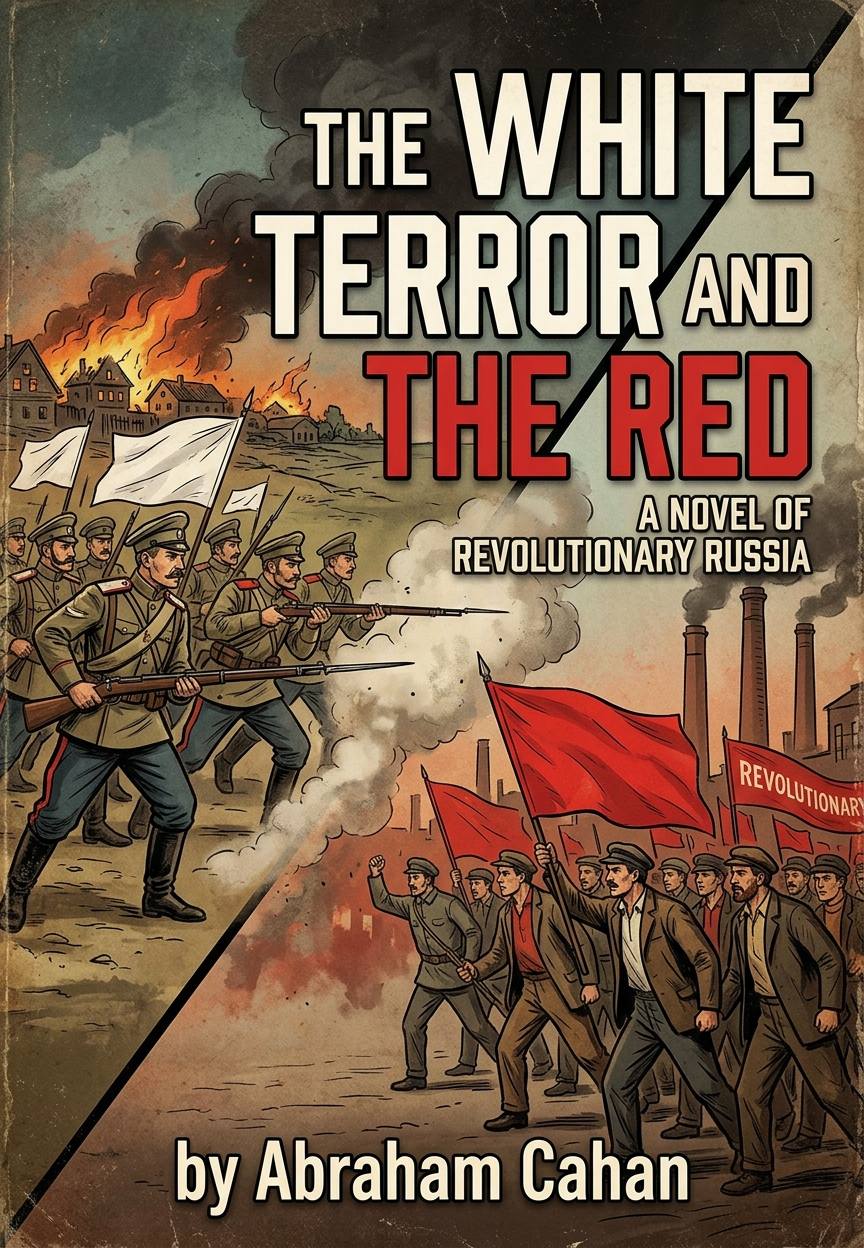
Abraham Cahan’s The White Terror and The Red: A Novel of Revolutionary Russia is a historical novel that examines Russia at a moment when political repression, revolutionary agitation, and social unrest were beginning to tear apart the established order. Rather than treating the revolutionary era solely as a struggle between opposing political forces, Cahan explores the human consequences of upheaval through characters whose personal loyalties are increasingly challenged by the realities of injustice.
At the heart of the story is Prince Pavel Boulatoff, a young member of the Russian aristocracy whose privileged upbringing places him close to the imperial establishment. Yet Pavel’s position does not shield him from the contradictions of the society in which he lives. As he encounters political persecution and the suffering of people caught in the machinery of repression, his unquestioning loyalty to the monarchy gradually gives way to doubt. His development becomes one of the novel’s central themes: the transformation of an individual who must decide whether inherited privilege and obedience are more important than conscience and justice.
Cahan introduces this conflict against the broader background of the reign of Czar Alexander II. Early in the novel, the emperor is presented during a summer stay in Germany, where he attempts, at least temporarily, to escape the rigid formalities of imperial life and experience something resembling ordinary existence. The episode provides an important contrast with the increasingly dangerous political atmosphere in Russia. Beneath the apparent stability of the empire, revolutionary ideas are spreading, opposition movements are gaining strength, and the authorities are responding with surveillance and repression.
Pavel’s intellectual and moral development is shaped in part by his relationship with his tutor, Alexandre Pievakin. Their conversations expose the competing ideas that define Russian society at the time. Loyalty to the Czar and respect for traditional authority collide with growing sympathy for people persecuted because of their political beliefs, nationality, or opposition to the regime. For Pavel, these debates are not merely theoretical. They force him to reconsider the assumptions on which his identity and social position have been built.
The story also brings the consequences of political conflict into sharper focus through figures such as Pani Oginska, a Polish woman whose life has been profoundly affected by the instability and repression surrounding her. Her experiences broaden the novel beyond the perspective of the Russian aristocracy, demonstrating how political decisions made by governments can reshape the lives of individuals and entire communities. Through such characters, Cahan portrays revolutionary Russia as a society in which political oppression and resistance are experienced not simply as abstract ideological forces but as deeply personal realities.
One of the novel’s most compelling elements is its attention to moral ambiguity. The conflict between the “White Terror” associated with state repression and the “Red” associated with revolutionary opposition is not presented merely as a simple contest between good and evil. Cahan is interested in the difficult choices produced when an oppressive political system confronts movements determined to destroy it. Violence, fear, idealism, privilege, and desperation become intertwined, leaving individuals to navigate circumstances in which every political position carries consequences.
Pavel’s journey therefore becomes a lens through which Cahan examines the collapse of certainty. A young aristocrat raised to respect the existing order gradually discovers that loyalty to authority can conflict with basic principles of human justice. His encounters with political dissent and suffering force him to ask whether a system deserves allegiance simply because it is established, and whether opposition to injustice can be justified even when it threatens the stability of society.
The novel’s opening discussions and encounters establish the ideological tensions that will shape the narrative. Russia appears outwardly governed by imperial authority, but beneath that surface lies a society increasingly divided by class, nationality, political conviction, and competing visions of the future. Cahan uses these divisions to explore the psychological effects of revolutionary change, particularly on people who are forced to choose between the world they inherited and the world they are beginning to imagine.
Ultimately, The White Terror and The Red is as much a story of political awakening as it is a historical novel. Through Pavel Boulatoff and the people whose lives intersect with his, Cahan portrays a society approaching a profound transformation. The novel asks difficult questions about authority, justice, privilege, resistance, and personal responsibility while depicting the pressures that cause established political loyalties to fracture.
By combining historical events with individual moral struggles, Cahan presents revolutionary Russia as a landscape of uncertainty in which neither political power nor rebellion exists without human cost. Pavel’s awakening reflects the larger crisis confronting the Russian Empire: once people begin to recognize the injustice embedded in the institutions around them, maintaining loyalty to the old order becomes increasingly difficult. The resulting conflict provides the foundation for a narrative about conscience, political change, and the turbulent passage from obedience to resistance.