
Teodor Korwin Szymanowski
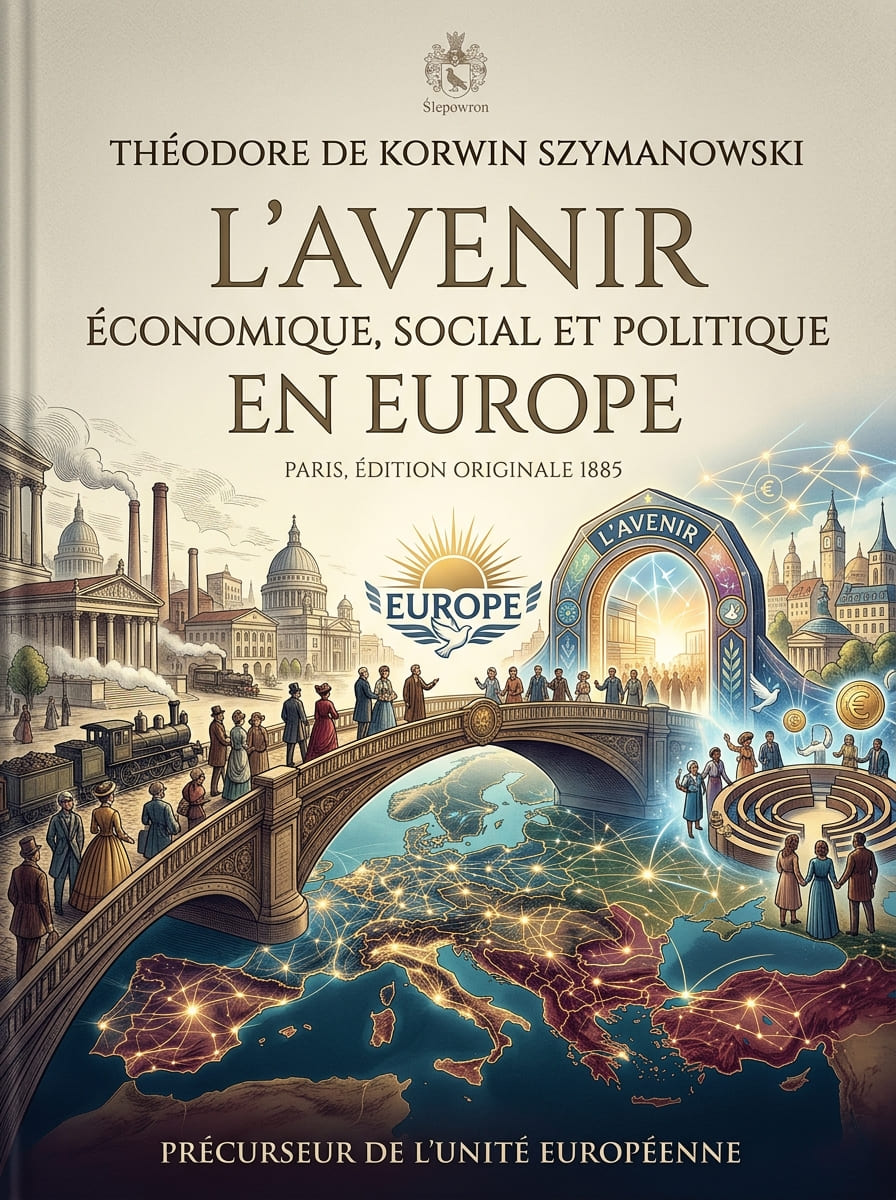
The work of Teodor Korwin Szymanowski reflects the dominant French cultural influence within the Szymanowski family dating back to the Age of Enlightenment, for example through Józef Szymanowski, the poet and translator of Voltaire. This influence was intensified during the Napoleonic period, when his father and close relatives from the Łubieński family served under Marshal Davout, as well as through Szymanowski’s own education and experience of the intellectual discipline of the French Jesuits, which he shared, incidentally, with Voltaire himself. His life was associated with a period marked by brutal repression, emigration, the decline of the landed gentry, and intensified Russification in the Polish territories.
Szymanowski’s political contacts in France and Russia, which he mentions in his writings, deserve further research. It is known that the background to his economic and political work, L’Avenir économique, social et politique en Europe, published in Paris in 1885 and 1888, was a deepening social and economic crisis. “Je suis un seigneur terrassé” — “I am a lord brought down to the pavement,” Szymanowski wrote in L’Avenir. When he completed his European thesis, he was forced to leave the land that his ancestors had inhabited for generations and moved deep into Ukraine. It is also known that the extensive Korwin-Szymanowski library was placed in Nakwasin with Bolesław and Jadwiga Nakwaski, Szymanowski’s brother-in-law and elder sister, where it survived until 1945. In Ukraine, Szymanowski was engaged in business.
Szymanowski proposed a united Europe based on a customs union, with a central bank organized around contributions made by each participating state, enabling government loans and using a single common currency — preferably the French franc. The entire system would be based on the collection of detailed statistical data from all participating countries. It would take another 70 years and two world wars before the architects of the European integration project, including Robert Schuman and Jean Monnet, began to put such ideas into practice.
Meanwhile, Szymanowski continued to develop his vision in publications on parliamentary reform, Conférence Internationale sur les réformes parlementaires, and on a customs union, Conférence Internationale Douanière.
Teodor Korwin Szymanowski L’avenir économique, social et politique en Europe, Paris, 2026.